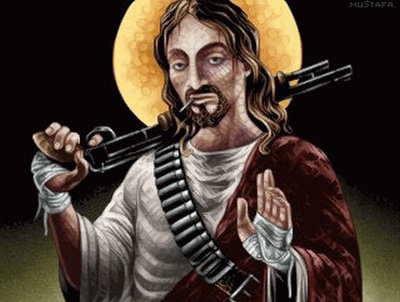
Funny thing is, Santa doesn't come from St Nicholas. It's from pagan traditions like Knacht Pieter and others I don't remember.?
10 comments
It's fundie for one of two reasons.
1. it's the whole "Christmas is ebil Satanic pagan shit and no Christian should involve themselves in it!"
or...
2. it's the whole "Christians steal everything from pagans and they're ebil and Paganism literally owns Christmas and Halloweens and Easter and etc. etc. etc."
So it's either Christian fundie or Pagan fundie. Or just flat-out misinformed which sometimes counts for fundie.
I don't see why this is fundie. If we're talking about the American Santa (and based on the name I'm guessing that is the case because most other places have other names for the character), then he owes only a slim fraction of his character to St. Nicholas. He's got more in common with Wotan than St. Nicholas. It would be simplistic to say that the character is not informed at all by St. Nicholas but to the extent that he was it was only 3rd or 4th hand and amalgamated with other popular characters.
@ lofgren
The American Santa has his origins in the Dutch Sinterklaas, which is very specifically Saint Nicholas. The earliest representations of Santa in the US come from the Dutch community. He's now confused with other countries' traditions; he's not from Spain but the North Pole, he doesn't have Zwart Piet, he's celebrated on the 25th and he's lost the bishop's outfit for the red suit, but it's still Sinterklaas.
@Hasan Prishtina
No, that is a wildly over simplified explanation. Yes, Sinterklaas was undoubtedly one of the inspirations for Santa Claus, but many of those other aspects that you mention have their roots in English traditions of Wotan, including his suit, the day of his visit, the reindeer, the rotundness, the elves, and on and on.
Sinterklaas was one of the 3rd or 4th hand borrowing of St. Nicholas that I referred to in my earlier post. It's worth noting that scholars strongly suspect that Sinterklaas, like Santa, was also a folk character who became associated with Saint Nicholas only later, albeit much more strongly so than Santa.
You basically said, "The American Santa is Sinterklaas, except for all the parts that aren't, which is most of them."
@ lofgren
"You basically said, "The American Santa is Sinterklaas
Let's stop right there. "Has its origins" and "is" are two very different prospects, especially when I explicitly state there are a mix of inspirations. Besides, the Americans did not borrow directly from pagan traditions; everything came to them from the borrowings already made by later Europeans; that's why we call a word like "amigo" a borrowing from Spanish, not Latin or Proto-Indo-European.
Confused?
So were we! You can find all of this, and more, on Fundies Say the Darndest Things!
To post a comment, you'll need to Sign in or Register . Making an account also allows you to claim credit for submitting quotes, and to vote on quotes and comments. You don't even need to give us your email address.